Gaithersburg, MD · Garage Door Service
Clarksburg homes mostly went up after 2010, so the doors we work on here are newer, insulated, and code-current. We drive out from Gaithersburg, 6 miles away.
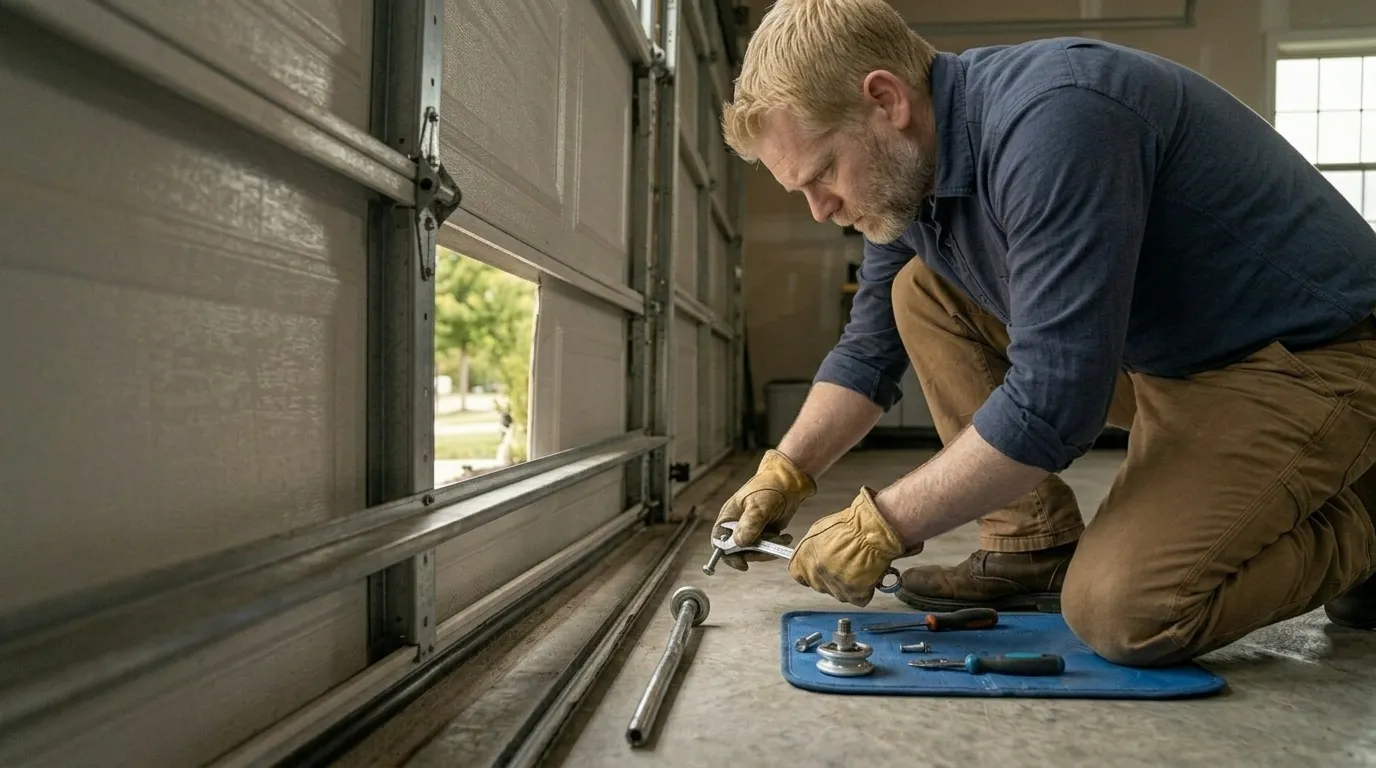
We run this call from our Gaithersburg shop, about 6 miles down the road. It's a short haul, not a satellite branch and not a depot - just a truck coming from the same place it always comes from. Clarksburg is one of the newer pockets in our coverage area, and that changes what's in the truck before we even leave.
Most of the towns we work show a mix of decades. Clarksburg doesn't. The subdivisions here went up mostly after 2010, well past the median build year of 1980 that describes the wider service area. That's not a small gap - it's a generation of hardware and code changes. A tech heading here loads different rollers, different sensor brackets, and different spring cores than a tech heading to an older block three miles over.
We also know Clarksburg households run a higher median income, $178,641, than the broader area's $139,953. In practice that shows up as more insulated steel doors, more full-view glass panel doors, and more openers with battery backup and smartphone control - options that cost more up front and that people here tend to have chosen rather than inherited.
A door built to 2010s spec is a different animal from a door built in 1978. Newer Clarksburg garages mostly run torsion springs sized for heavier insulated sections, nylon or steel rollers on sealed bearings, and openers with photo-eye safety sensors built in from day one rather than retrofitted. When something breaks, it's rarely the ancient one-piece slab problem - it's a broken spring under higher tension, a misaligned safety sensor on a door that's barely a decade old, or a logic board issue on a newer opener rather than a worn-out gear set.
The cold band this whole region sits in still applies here the same as anywhere else in the service area - winters cold enough to stiffen grease, shrink metal, and put extra strain on springs and cables during the first hard cold snap. That part doesn't change with build year. What changes is that a 2010s door usually has better weatherstripping and a tighter seal to start with, so when a homeowner calls about a draft or a door that won't seat right, it's often a sensor or track alignment problem, not a door that was never sealed well to begin with.
With roughly 8,989 households, Clarksburg is a smaller slice of the wider service footprint of 281,761 households and 104,291 owner-occupied houses, but it's a distinct one. A median build year of 2010 puts most of these houses well inside modern residential code for garage doors - required photo-eye sensors, auto-reverse mechanisms, and in a lot of cases insulated steel construction from the builder rather than added later.
That means fewer calls here about ancient extension springs with no safety cable, and more calls about factory openers reaching the end of their circuit board life, or about wall consoles and remotes that need reprogramming after a power event. It also means when a homeowner does want to upgrade, they're usually going from a builder-grade door to something heavier or better insulated, not replacing something falling apart.
One honest limitation: we don't stock every proprietary opener logic board on the truck. Some newer builder-installed openers use manufacturer-specific parts with longer lead times than a universal replacement would need, and we'll tell you that up front rather than have you wait on a part that isn't coming.
In Clarksburg specifically, the calls skew toward opener electronics, sensor alignment, and spring replacement on heavier insulated doors rather than the total-teardown jobs we see on older 1960s and 70s housing stock elsewhere in the area. A door here is less likely to need a full frame rebuild and more likely to need a spring swapped to match a heavier panel, a sensor re-aimed after a car bumper clipped it, or a smart opener paired again after a router reset.
We also get called out for seasonal cold-weather trouble - a cable that's gone slack, a track that's binding after the first freeze - same as the rest of this cold-climate region, just showing up on newer hardware than you'd find in an older neighborhood. If your door is original to a house built in the last 10 to 15 years, chances are good the fix is a component swap, not a full replacement.
No. We work out of Gaithersburg and drive to Clarksburg, about 6 miles away, for calls. There's no local depot here - just the same truck and same team that covers the rest of the area.
Newer insulated steel doors are heavier than older uninsulated ones, so the torsion springs run under more tension and wear differently. It's not a sign of a bad door - it's the tradeoff for the extra insulation, and it's a normal repair on a house built in the last decade or so.
Often, yes. Houses here mostly went up after 2010, so openers usually already have built-in photo-eye sensors and auto-reverse rather than retrofitted ones. Some builder-installed openers use proprietary logic boards that can take longer to source than a universal replacement.
Call now or request a free quote - same-day service on most repairs, upfront written pricing.