Gaithersburg, MD · Garage Door Service
Wheaton homes built around 1959 still run original torsion hardware not sold anymore. We travel from Gaithersburg to fix springs, cables, and openers on this older stock.
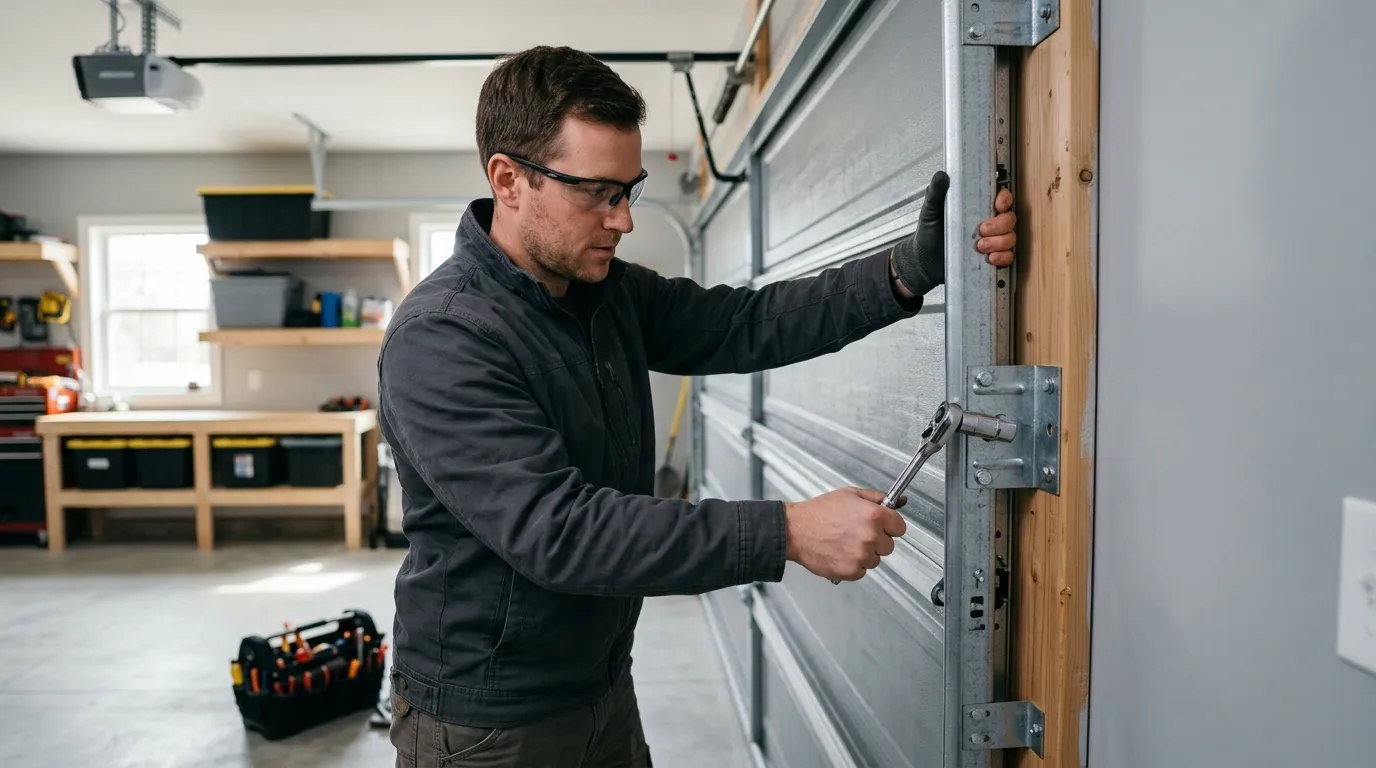
Most houses in Wheaton went up around 1959, well ahead of the newer construction you'll find closer to the middle of the service area, where median build year runs closer to 1980. That matters on a garage door because 1959 construction usually means a single-panel or early sectional door hung on hardware nobody manufactures anymore: narrow-track rollers, undersized torsion springs sized for a lighter door, and drums that don't match what a big-box store stocks today.
When one of these springs finally lets go, the fix isn't a swap-in part off a shelf. We often have to special-order a spring wound to the original door's weight and drum size, or convince the homeowner that a full hardware upgrade is cheaper in the long run than chasing parts for a 65-year-old track system. The other failure we see a lot here is the cable fraying at the drum groove because the drum itself is undersized for the cable gauge that's been swapped in over the years by whoever repaired it last. That's a mismatch, not a defect, and it recurs until someone corrects the whole assembly, not just the cable.
Cold, damp winters here don't help old steel. Rust at the spring coils and roller stems shows up faster on this vintage of hardware than it does on anything built after 1980.
A straight spring replacement on original 1959 hardware usually runs longer than the same job on a newer door, because we're often measuring and confirming spring specs on site rather than pulling a stock size off the truck. Budget more time if the drums or cable size need correcting too, since that's not a swap, it's a rebuild of the whole lift side.
Opener repairs move faster regardless of the house's age, since openers get replaced independently of the door itself and most homes here have had at least one newer unit installed over the decades. Track and roller work falls in between - straightforward if the track is original and just bent or worn, slower if someone has already patched it with mismatched parts over the years, which we see often on doors this old.
We're driving in from Gaithersburg, about 10 miles out, so factor that into when we can get there rather than how long the repair itself takes once the truck's in the driveway.
Tell us the age of the house if you know it, or just say it's an older Wheaton home - that alone changes what we bring on the truck. A door on original 1959 track needs different spring stock and drum sizes than a door installed in the last twenty years, and knowing that before we load up saves a second trip.
If you've had any part of the door replaced before - a new opener, a new cable, a patched panel - mention that too. Mixed-vintage doors are common here after 65 years of small repairs, and half our diagnostic time on an older Wheaton call is figuring out which parts are original and which aren't.
We travel out from Gaithersburg for these calls, so a clear description of the symptom and the door's rough age helps us show up with the right parts the first time instead of turning a same-visit fix into a return trip.
We don't have a published price list for this specific job, and giving you a number without seeing the hardware would be a guess dressed up as a quote. What we can tell you is that older Wheaton doors - the 1959-era stock especially - tend to cost more on the parts side than a repair on a newer door, because original-spec springs and drums aren't stocked the way current sizes are.
Household income in the broader service area runs a median around $139,953, but Wheaton itself sits closer to $107,349, and we mention that only because it's relevant to how homeowners here often ask us to weigh repair against replacement - a full hardware and door replacement can be the better dollar-for-dollar move once you're chasing discontinued parts twice in five years.
We'll always give you the repair cost and the replacement cost side by side before we touch anything, so you're deciding with real numbers, not a sales pitch.
The door that won't budge, or moves a few inches and stops, is the most common call from Wheaton's older homes. Nine times out of ten on a house this age it's a torsion spring that's finally given out after decades of cycling on hardware that was never oversized to begin with.
A close second is a door that opens fine but slams down the last foot instead of lowering evenly - that's usually a cable that's stretched or slipped off an undersized drum, again tracing back to hardware that doesn't match modern cable gauge. Grinding or popping noises partway through the cycle point to roller stems worn thin inside track that's narrower than what gets installed today.
If the opener runs but the door doesn't move at all, that's a separate problem from the mechanical stuff above - usually the opener's disengaged from the track, which is quick to check before assuming the worst.
The job goes wrong when someone treats a 1959-era door like a modern one and orders a standard replacement spring. It'll fit the coil but not the drum ratio, and the door either won't balance or it over-tensions and snaps again within a year. We've had to redo other contractors' work here for exactly that reason.
It also goes sideways when a homeowner has had three or four small patch repairs done over the years - a cable here, a roller there - and nobody's checked whether those parts actually match each other or the original track spec. At that point a
placeholder
Most homes in Wheaton were built around 1959, and doors from that era used narrower track, smaller drums, and torsion springs sized for lighter panels than what's standard today. Those exact parts often aren't stocked anymore, so a repair may mean special-ordering a spring wound to the original spec or upgrading the hardware outright.
No. We're based in Gaithersburg, about 10 miles away, and drive out to Wheaton for calls. There's no local branch or depot here, just a truck coming from the main shop.
It depends on how much original hardware is left. If the springs and drums are still 1959-spec and failing, chasing discontinued parts repeatedly can cost more over a few years than replacing the whole assembly once. We'll price both before starting so you can compare.
Faster than on newer doors, mostly because the original track and drums here weren't sized for the cable gauge that's often been swapped in during past repairs. Combined with cold winters that rust steel components, we see roller and cable wear show up sooner on Wheaton's 1959-era doors than on newer stock elsewhere in the service area.
Call now or request a free quote - same-day service on most repairs, upfront written pricing.