Gaithersburg, MD · Garage Door Service
Panel replacement for North Potomac's late-1980s steel sectional doors. Gaithersburg Garage Door Pros travels 4 miles to match embossed panel profiles and swap damaged sections.
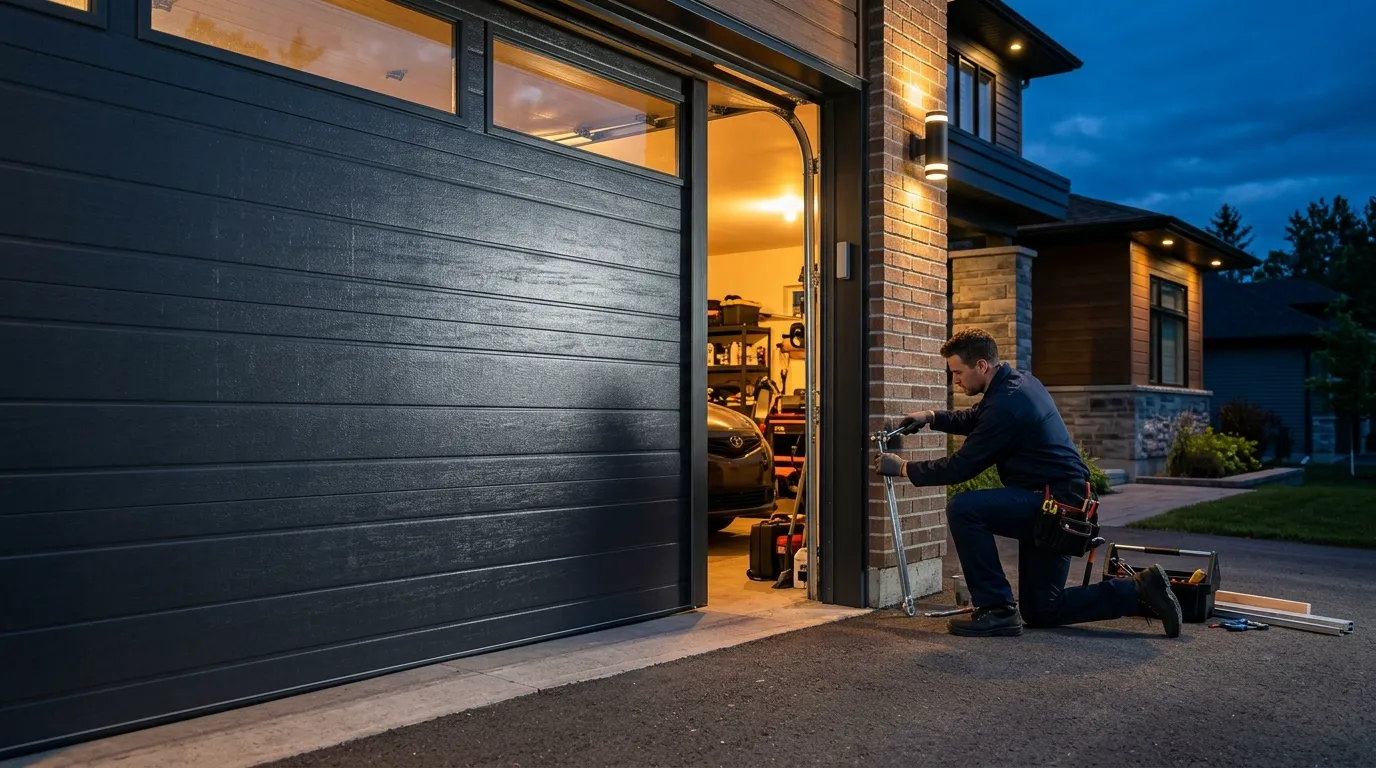
Most garage doors in North Potomac went up around 1988, which puts them squarely in the run of embossed steel sectional doors builders favored through the late 80s and early 90s - raised-panel faces, usually four or five sections stacked on a standard 16x7 double or 9x7 single frame, with a stamped wood-grain texture that was the look of the decade. The steel gauge on these is thinner than what goes into a door today, and after three-plus decades the panels take the brunt of it: a bumper tap that dents one section, a hinge pulling loose from a panel edge that's started to fatigue, or a bottom panel that's rusted through where snowmelt sits against it. You'll see the dent or the crease before you see anything wrong with the opener or the springs - the panel is the part that shows the hit first, because it's the part with no give left in the metal.
By the time a homeowner calls, usually one or two sections are visibly bent or split, while the rest of the door still tracks fine. That's a panel job, not a full door replacement - but only if the section still exists to be matched.
We don't quote panel work over the phone without seeing the door, because the cost swings on one thing: whether your door's panel profile is still made. A straightforward section swap on a common embossed profile is a different job, in time and parts, than sourcing an obsolete panel or special-ordering a color match. What we can tell you going in is that North Potomac homes carry median household incomes well above the wider Gaithersburg service area - $186,438 versus the broader region's $139,953 - and that shows up less in what the repair costs and more in what people ask for: better-matched panels, insulated replacements instead of the thinnest available section, and full-door quotes run alongside the panel quote so the choice is informed rather than default.
We travel the 4 miles from Gaithersburg for the visit itself; there's no separate trip charge built into that distance, but there's also no local stock sitting closer than our shop, so lead time on a discontinued panel is the same whether you're 4 miles out or across town.
The area sits in a cold, severe winter climate, and that matters more for panels than people expect. Steel doesn't like the freeze-thaw cycle much on its own, but the failure point is usually the seam where a panel meets its neighbor or the hinge line - repeated contraction in cold, expansion when the sun hits the door face, and eventually the embossed surface starts to crease at a stress line even without an impact. On a door built when yours was, that stress line often shows up on the bottom two panels first, since they take the temperature swing at the slab and the impact risk from cars, bikes, and salt-crusted boots.
We also see it on doors that never got hit at all - just thirty-some winters of the material working, cycle after cycle, on a panel gauge that wasn't built for a forty-year run. That's a straight materials-and-climate story, not a one-time accident, and it's why panel failure clusters by build year almost as reliably as it clusters by impact.
We come out from Gaithersburg to look at the door in person before quoting anything - panel matching isn't a phone estimate, since the profile, the finish, and the section height all have to line up with what's already hanging. Bring us a clear photo of the damaged section and the door's data plate if you can find it; that speeds up sourcing before we even arrive. See the North Potomac service area page for what else we cover out this way, or the Gaithersburg panel replacement page for the general rundown on how this job works across the wider area.
We're honest about one limit up front: if your door's panel profile was discontinued years ago and a close-enough match isn't available, we'll say so and quote a full door instead of stringing you along on a part that isn't coming.
A single-panel swap on a door with a matchable profile is a same-visit job in most cases - unbolt the hinges and end stiles from the damaged section, lift it out of the track, drop in the replacement, and reset the hinges and rollers. Where it stretches out is sourcing: if the panel isn't a current stock item, we're waiting on a special order, and on a door pushing 35 years old that's common rather than rare.
We also check the sections above and below the damaged one while we're in there. On a door this age, one bad panel is often a sign the others are close behind, and it's worth knowing that before we close the truck up rather than finding out next winter.
If your door's profile is still in production, yes, close enough that it won't be obvious from the driveway. If it's an older embossed pattern that's been discontinued - common on doors from the late 80s - we'll be upfront that the match may be close rather than exact, or that a full door is the better call.
Usually it's impact - a car bumper, a bike, a stray basketball - hitting one section directly. On older steel doors, cold-weather stress cracking at a seam can also isolate to one or two panels, especially the bottom ones, before it spreads anywhere else.
Often, yes, if the profile is in stock and the rest of the hardware - track, springs, opener - is sound. If the panel has to be special-ordered or several sections are failing at once, we'll walk you through the full-door price alongside it so you're not guessing.
Call now or request a free quote - same-day service on most repairs, upfront written pricing.