Gaithersburg, MD · Garage Door Service
Damascus homes went up mostly around 1983 - most still run original springs and openers from that era. We travel the 8 miles from Gaithersburg to fix what's failing now.
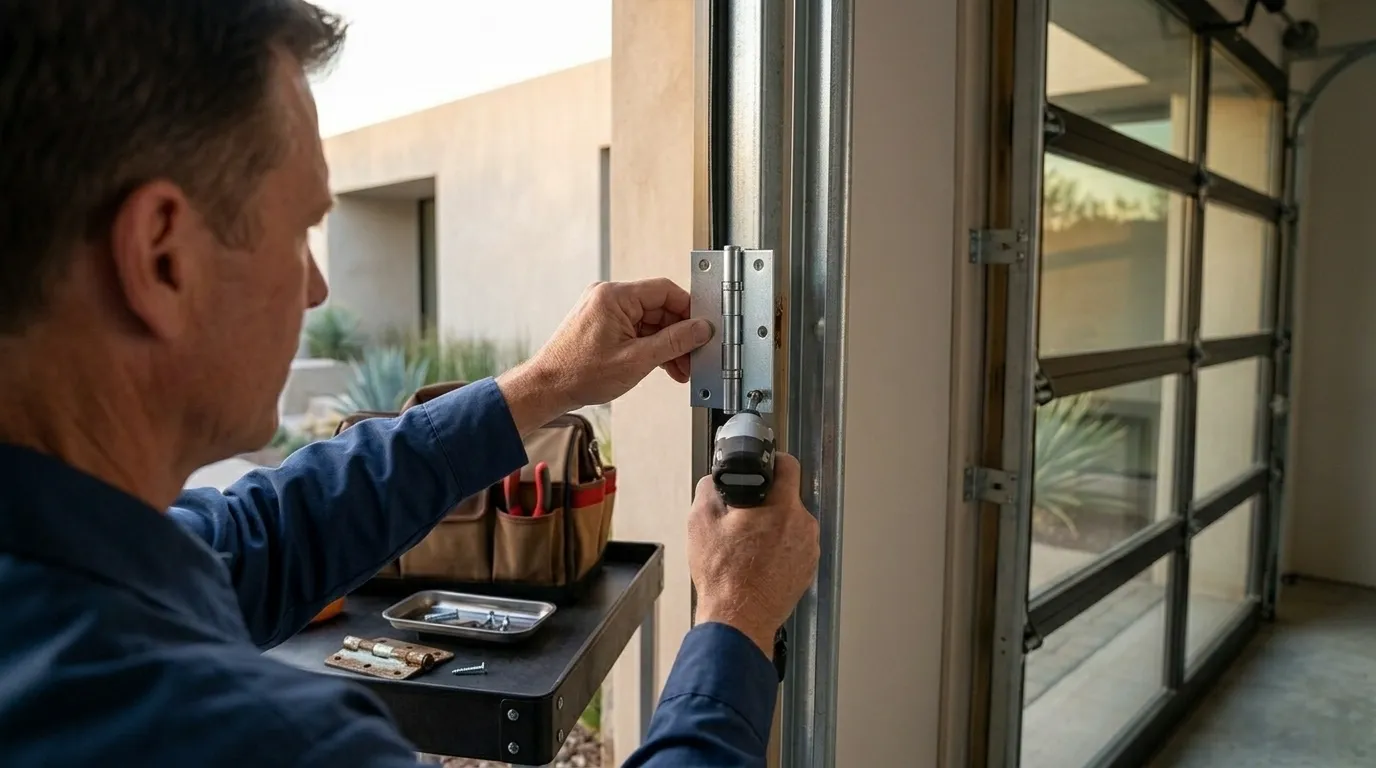
Damascus sits at the far edge of our service area, about 8 miles out from Gaithersburg, and the houses we see there cluster around a median build year of 1983. That matters more than it sounds like it should: a door installed in 1983 has had roughly forty years to wear out one spring, one set of hinges, one opener motor - and in a lot of these houses, none of it has ever been swapped. If your door is original to the house, you're not dealing with a modern torsion system with a safety sensor bar and a soft-close motor. You're dealing with hardware that predates most of the safety code updates that came later.
You can grease hinges, tighten loose bolts, and clear the track of debris yourself, and that's worth doing regardless of the door's age. What you should not do on a door this old is touch the spring. A wound torsion spring on original 1980s hardware stores enough force to break a bone or worse, and the winding cones on older units don't match what's sold in stores now. If the door won't open, or opens crooked, stop and call rather than improvise a fix on a spring system you can't identify.
On a door this age, the repair usually starts with figuring out what's actually original and what's been touched. A lot of Damascus doors have had the opener replaced once - openers fail more often than doors - but the springs, drums, and track are frequently still the parts that went in with the house. That changes the job: we're not always swapping a like-for-like part, because the like-for-like part hasn't been made in years. Sometimes that means adapting a modern spring to old drums, and sometimes it means telling you the drums need to go too.
We carry standard torsion springs, cables, rollers, and openers on the truck for the common sizes. What we can't always carry is an exact match for hardware that's forty-plus years old and no longer in production - if your setup needs a part that's been discontinued, that can mean a short wait while we source it, rather than a same-visit fix. That's the one honest limit here: the truck handles the common failures fast, but original 1983 hardware occasionally needs a part nobody stocks.
We don't have a set price to quote you blind, and any number given without seeing the door and its hardware would be a guess. What we can tell you is what drives the cost up on a Damascus job specifically: age of the parts, not just the failure itself. A broken spring on a five-year-old opener is a straightforward swap. A broken spring on a door where the drums, track, and hinges are all original from 1983 often turns into replacing more than the spring, because the rest of the hardware is at the same point in its life and one more part failing under new tension isn't worth the risk.
Damascus households run a median income noticeably higher than some of the areas we cover closer to Gaithersburg, and we mention that only because it shapes a real decision homeowners here face: replace the whole door and opener now on a house that's been solid for forty years, or patch the failing part and accept you'll be back at this again inside a year or two. Neither answer is wrong. It depends on what else in the system is showing its age.
The most common way this goes wrong in Damascus is a homeowner replacing just the spring on an original 1983 system and having a cable or roller fail within months, because everything on that door has been under the same stress for the same four decades. Spring failure is rarely isolated hardware failure - it's often the first part to give out, not the only one close to giving out.
The second way it goes sideways is size and weight mismatch. Doors from this era, especially on wider two-car openings, often used heavier panel material than what's standard today. Swap in a lighter modern door on old torsion hardware sized for the heavier original, and the spring tension is wrong from day one - the door will feel light going up and heavy coming down, or won't hold position at all. That's a sizing problem, not a defective part, and it only shows up because the hardware and the door date to different points in the house's life.
The complaint we hear most from this stretch of the county is a door that used to open smooth and now grinds, shudders, or hangs partway up. On a house from 1983, that's consistent with worn bearings in the drums or a spring that's lost tension after decades of cycles - plain fatigue, not damage from one bad event. It's a slower failure than a snapped cable, and it's easy to ignore for months because the door still technically works.
The other symptom worth naming is an opener that runs but the door barely moves, or reverses immediately. On original hardware, that's often the opener straining against a spring that's no longer doing its share of the lift. Replacing the opener alone in that case fixes nothing - the new motor just fails the same way, faster, because it's fighting the same worn spring.
This region sits in a cold climate zone with real seasonal swings, and metal spring steel loses tension differently depending on how many freeze-thaw cycles it's been through. A spring installed in a house built in 1983 has been through roughly four decades of that cycle. That's not a Damascus-specific fact so much as a housing-age-specific one, but it's the housing age that makes Damascus different from newer construction closer in toward Gaithersburg.
Across the wider service area, most of the housing stock dates to the 1980s and 90s, and Damascus's 1983 median puts it right in that band rather than at either edge. What that means practically: parts fail on a fairly predictable timeline tied to installation year, and a lot of Damascus doors are approaching or past the point where original hardware, not just the newest broken part, is the actual problem.
No. We're based in Gaithersburg and drive out to Damascus for calls - it's about 8 miles. We don't have a branch or depot there, just a truck that comes when you call.
It can be. A lot of the springs, drums, and track from that era were made to specs that have since changed. Common parts like standard torsion springs and openers we carry on the truck. Original hinges or drums specific to an older door sometimes need to be sourced, which can mean a short delay.
Depends on what's failing. If it's one part on hardware that's otherwise sound, repair makes sense. If the spring, cables, and rollers are all original and all near the same age, replacing more than the one broken part is usually the better call - we'll tell you which situation you're in once we've looked at it.
Usually uneven spring tension, which shows up more often on older torsion systems where one spring has lost strength faster than the other. It's a common issue on hardware that's been in place since the house was built.
Call now or request a free quote - same-day service on most repairs, upfront written pricing.